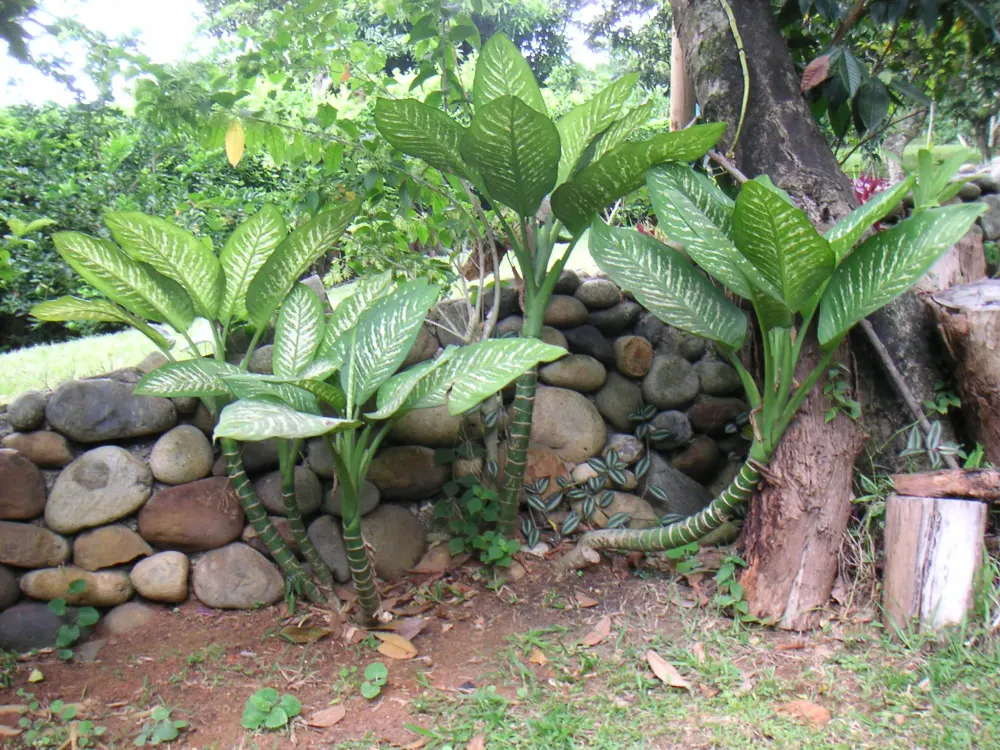
© Louise Wolff --darina 00:30, 7 May 2005 (UTC) · CC BY-SA 3.0 · Commons
Dieffenbachia
Toxic🐾Dieffenbachien · (Dieffenbachia seguine)
Arum family (Araceae)
Description
Dieffenbachia, commonly known as dumb cane or leopard lily, is a genus of tropical flowering plants in the family Araceae. It is native to the New World Tropics from Mexico and the West Indies south to Argentina. Some species are widely cultivated as ornamental plants, especially as houseplants, and have become naturalized on a few tropical islands.
External use only!
This plant must NOT be taken internally. Use only as compress, salve, or bath.
CONTRAINDICATED during pregnancy
Do not ingest. Safe as a houseplant with normal distancing.
CONTRAINDICATED during breastfeeding
Do not ingest. Safe as a houseplant with normal distancing.
CONTRAINDICATED for children
ABSOLUTELY keep away from children. Even brief chewing can cause airway obstruction.
- RawWhole plantExternalTraditional use
When kept as a houseplant, dumb cane filters formaldehyde and xylene from indoor air. The Wolverton study (NASA 1989) lists it as one of the most effective indoor air-purifying plants.
- RawWhole plantExternalFolk medicine
Historical-ethnobotanical only: In the Caribbean, Dieffenbachia was used against paralysis — a dangerous practice with no therapeutic basis. For historical record only, not to be replicated.
- RawWhole plantExternalTraditional use
Ornamental houseplant with distinctively patterned leaves; thrives even in shaded areas, improving indoor air quality there.