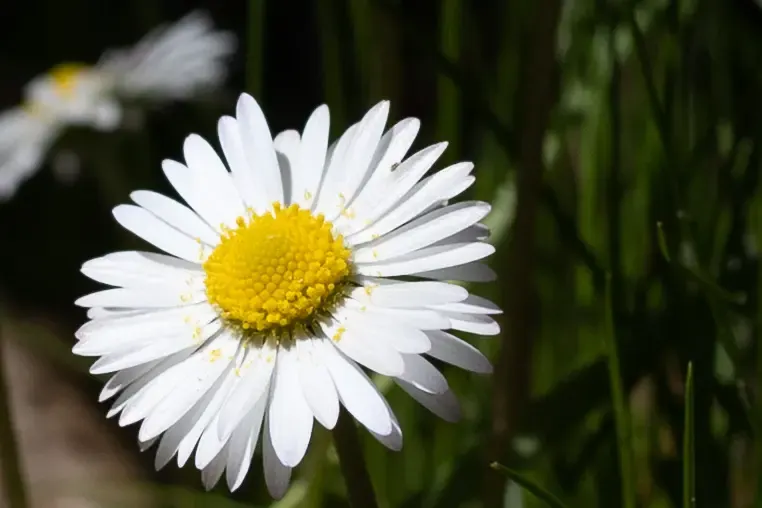
© Matthias Süßen · CC BY-SA 4.0 · Commons
Bellis perennis
Gänseblümchen · (Bellis perennis)
Daisy family (Asteraceae)
Description
Flowering almost year-round, the common daisy is one of the most familiar wildflowers on lawns and meadows and is often called arnica's gentler sister. Salves and cooling compresses made from its flowers and young leaves are a traditional remedy for bruises, contusions and minor wounds, mild enough to be used on children. A very mild flower tea is used in folk medicine for spring cures and slight respiratory irritation, though scientific studies are lacking. Raw, the flowers and young leaves have a mild, nutty taste and work well as an edible salad ingredient. Because no EMA monograph or large clinical trials exist, every use rests on long-standing folk tradition; the tea should be drunk only sparingly, and skin irritation occasionally occurs in people with a daisy-family allergy.
Classic home-remedy salve for bruises and minor wounds — the gentler sister of arnica, traditionally also used for children.
Preparation & dosage
DAISY SALVE: Fill a clean jar 2/3 with freshly picked daisies (~50–100 g per 250–500 ml oil). Cover with cold-pressed olive oil (or sweet almond oil), close jar, place in warm, light spot for 3–4 weeks, swirl daily. Strain through muslin, press plant material. Per 100 ml oil melt 10–12 g beeswax, stir in oil. Apply thinly 1–2× daily to bruises, contusions, sprains.
- Dry amount
- 50–100 g
- Liquid amount
- 250–500 ml
- Max duration
- 4 weeks
Cooling compress for fresh bruises, contusions, swollen joints and minor skin irritations.
Preparation & dosage
MOIST COMPRESS: 5–10 g fresh or dried daisies + 250–500 ml hot water, steep 10–15 min covered, strain, cool to lukewarm. Soak cloth, apply 15–20 min to affected area. Repeat 2–3× a day. Alternatively: crush fresh leaves and flowers as green poultice — classic children's home remedy for grazed knees.
- Dry amount
- 5–10 g
- Doses per day
- 3×
- Max duration
- 2 weeks
Very mild folk-medicine tea for spring cures and mild respiratory irritation — traditional use without modern evidence.
Preparation & dosage
DAISY TEA (very mild, traditional): 1–2 g dried flowers in 150–250 ml boiling water, steep 5–10 min covered, strain. Max 2 cups a day, no longer than 1–2 weeks. Traditional spring cure or mild respiratory irritation. Purely traditional — no modern clinical trials or EMA monograph.
- Dry amount
- 1–2 g
- Doses per day
- 2×
- Max duration
- 2 weeks
⚠ Age restriction: ≥ 12 years — Internal tea use only from 12 years. External use (salve, compress) has been used for younger children for generations.
Edible wild plant — flowers and young leaves as a mild salad ingredient.
Preparation & dosage
WILD-SALAD INGREDIENT: Sprinkle young leaves and fully opened flowers raw into wild-herb salads, onto buttered bread, or as edible decoration. Flavour: mild, slightly nutty, faintly bitter. Wash well before use.
Sources: [1]
Bellis perennis has no EMA monograph and no large clinical trials — uses are purely traditional. Externally well tolerated for generations; skin irritations rare. Internally use sparingly: max 2 cups tea daily, no longer than 1–2 weeks. For non-healing or infected wounds always seek medical advice.
⏱ Max continuous use: 2 weeks
No systematic data. Better avoid internal use during pregnancy. External use on intact skin considered safe.
Insufficient data for breastfeeding. Internal use not recommended; external use away from nipple area traditionally safe.
Externally a classic children's home remedy for generations — the child-friendly arnica. Internally only in household amounts; concentrated tea or tincture only from about 12 years.
Contraindications
- Hypersensitivity to Asteraceae such as arnica, marigold, chamomile or mugwort — cross-allergy possible.
- Long-term internal use (over 2 weeks) not recommended due to lack of safety data.
Harvested part: flowers and young leaves
- Time of day:
- On dry mornings once dew has dried and flowers are fully open.
- Drying:
- Pick only fully opened, blemish-free flower heads. Spread in single layer in shade, dry at max 35 °C. Prefer clean meadows away from dog paths and roads.
- Storage:
- 12 months — Store airtight, dark and dry — use within a year.
- Time of day:
- Mornings after dew has dried; pick young, tender leaves.
- Drying:
- Best used fresh in salads. For drying spread out in single layer in the shade at max 35 °C.
- Storage:
- 6 months — Store airtight and dark, use within 6 months.
- Saponine (Triterpensaponine, u.a. Bayogenin-Glykoside)SaponinContent: ca. 2–3 %Flower
Main active group — mildly irritant, expectorant and traditionally support wound healing.
- Flavonoide (Apigenin, Kämpferol, Quercetin-Glykoside)FlavonoidAerial parts
Antioxidant and mildly anti-inflammatory.
- GerbstoffeTanninLeaf
Small amounts — mildly astringent.
- Polyacetylene (Polyine)OtherAerial parts
In traces — typical of Asteraceae, mildly antimicrobial.
- BitterstoffeBitterLeaf
Small amounts — give leaves the slightly tart flavour.
- SchleimstoffeMucilageFlower
Small amounts — contribute to mildly soothing effect.
- [2]BookGänseblümchen (Bellis perennis) — Volksmedizinische Anwendung, klassische Phytotherapie-Literatur (Heilkräuter-Lexikon)(accessed: 2026-05-18)
- [3]BookBellis perennis — King's American Dispensatory (Henriette's Herbal Homepage)(accessed: 2026-05-18)
- [1]WikipediaBellis perennis — Plants For A Future (Datenbank essbarer und medizinischer Pflanzen)(accessed: 2026-05-18)