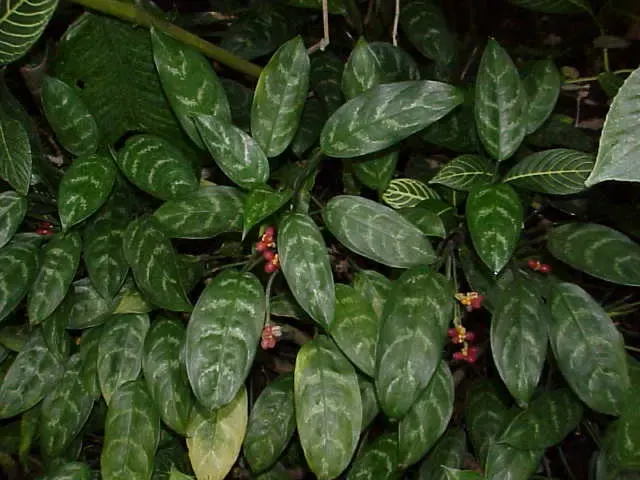
© Kurt Stüber [1] · CC BY-SA 3.0 · Commons
Aglaonema commutatum
Toxic🐾Kolbenfaden · (Aglaonema commutatum)
Arum family (Araceae)
Description
Decoratively patterned, silvery-green variegated leaves make this tropical member of the arum family one of Asia's most popular houseplants, cultivated for centuries there as a bringer of good fortune. It thrives year-round in moderate light and, according to the NASA Clean Air Study, is associated with reducing benzene and formaldehyde levels indoors. In parts of Southeast Asia, leaf extracts are traditionally applied externally for skin rashes, although the sap itself can cause irritation. WARNING: all plant parts contain calcium oxalate crystals that cause mucous membrane irritation, salivation and difficulty swallowing if ingested; skin contact with the sap can trigger painful rashes. Toxic to cats and dogs — keep out of reach of children and pets.
External use only!
This plant must NOT be taken internally. Use only as compress, salve, or bath.
Chinese Evergreen is cultivated as a houseplant and, according to the NASA Clean Air Study, contributes to reducing benzene and formaldehyde in indoor air.
Sources: [1]
In parts of Southeast Asia, leaves of Chinese Evergreen are traditionally used in folk medicine externally for skin rashes, although the plant sap itself can cause skin irritation.
In Asia, Aglaonema species have been cultivated as luck-bringing ornamental plants for centuries and are a staple of Asian interior decoration.
Sources: [2]
⚠ External use only
TOXIC to humans and pets: calcium oxalate crystals in all plant parts cause mucous membrane irritation, salivation, and difficulty swallowing. Plant sap can cause skin irritation and painful rashes on contact.
No safety data available during pregnancy. Avoid as a precaution.
No safety data available during lactation.
Calcium oxalate crystals can cause intense oral irritation in children. Keep plant out of reach of small children.
Contraindications
- Do not use internally — all plant parts are toxic due to calcium oxalates.
- Avoid skin contact if known sensitivity to Araceae (arum family) plants.
Harvested part: whole plant (decorative)
- Time of day:
- Suitable year-round as a houseplant — no seasonal harvest timing.
- Drying:
- Not used dried — exclusively as a living plant for air purification.
- Time of day:
- Leaves for ethnobotanical purposes harvested during the growing season (spring–autumn).
- Drying:
- For folk external use, fresh leaves preferred; not for internal use.
- Calcium oxalateOtherWhole plant
Insoluble calcium oxalate raphides (needle crystals) in all plant parts — cause mechanical irritation and burning on contact with mucous membranes or skin.
- Steroidal saponinsSaponinLeaf
Steroidal saponins are typical of the Araceae family and contribute to general toxicity.
- FlavonoidsFlavonoidLeaf
Flavonoids (including quercetin derivatives) in leaves — mildly antioxidant.
- Phenolic acidsPhenolic acidLeaf
Phenylalanine-derived phenolic acids in small amounts in leaves and stems.
- Benzene (absorbed)OtherWhole plant
Not a constituent of the plant itself but an absorbed air pollutant — the plant takes up benzene from indoor air and metabolises it.
- Formaldehyde (absorbed)OtherWhole plant
Formaldehyde is absorbed from indoor air and broken down within the plant, according to the NASA study.
- [1]MonographInterior Landscape Plants for Indoor Air Pollution Abatement (NASA TM-101766)(accessed: 2026-05-24)
- [4]MonographCliniTox Giftpflanzen — Aglaonema commutatum Schott.: giftig + (Institut für Veterinärpharmakologie und -toxikologie, Universität Zürich)(accessed: 2026-08-10)
- [2]WikipediaAglaonema (Wikipedia EN)(accessed: 2026-05-24)
- [3]WikipediaKolbenfaden (Wikipedia DE)(accessed: 2026-05-24)
Distribution in Europe
🪴 Grow at home
- ☀ Light
- low light
- 💧 Water
- weekly
- 🌱 Soil
- Standard potting compost
- 🪴 Pot
- 20 cm
- ⭐ Difficulty
- ★☆☆ beginner
- 🐾 Pets
- toxic to pets
Tips:
- Tolerates very dark corners — one of the most shade-tolerant houseplants.
- Likes warm rooms (>18 °C), no draughts.
- Variegated cultivars need more light than green ones.
Care tips are general indoor-gardening recommendations, not scientific sources.